Preparing now for the lady of the manor to return, I'll have one more bath in this claw foot rub (is there any more elegant a place to wash?) then wash it of my hair. I swear: when alien archaeologists excavate our world in search of things to clone, they will come across enough scraps of me to build a full-scale model
Saturday, November 27, 2010
Friday, November 26, 2010
Remembering summer in the snow-melt
There was this one day in the summer...three boys out clambering on rocks, skipping stones, catching salamanders...sublime, ordinary...we remembered when we used to do these very things, when we were nine or ten and now we three at three times that age can still get fifteen skips and make up hidden lives for high school teachers and remember friends moved away
Thursday, November 25, 2010
fire lit and typing begun
I'm dog-sitting for a friend from the church choir, and I'm just so happy to be doing so. Sitting by the fire in the morning with a cup of coffee and my work computer all booted up and ready to go. My emails are checked, the dog's been let out and I'm about to fire off a message saying that I won't be going into the office because all that snow is expected to melt by tomorrow, and I will go in then.
It is hard for me to express just how well I live. I eat well. I sleep well. I have warm clothing and people to laugh with. I am consistently overwhelmed by all of this, but this morning, as I got the fire lit and my typing begun it hit me a little harder than usual.
Monday, November 22, 2010
An outage and an outing
when the power goes out on me. Bah. As a direct result my roommate and
I are headed out to participate in one of his odder hobbies: lifting
heavy objects. Except this time it is in service of someone else.
As roomie and I are sitting, discussing the logistic of fecal
elimination by candle light, he shows me the video he took from the
Dimmu Borgir concert he went to last night while I was at church. If
you know the thrust and tenor of Norwegian Black Metal you will know
why I think that's funny.
But, more seriously, I am well convinced that God loves good Metal. I
have much more to say on that, but it will wait until I am not typing
on my phone.
getting ready for a new year
It's a new year coming up. First of advent next week. Lectionary year A, no less. A great time for beginning. Always beginning. Many things to begin:
- Writing here: The impulse to write has resurged and will become a useful tool for me to warm up for my work day
- The Daily Office: So difficult to maintain a practice on my own, but I may have found some folk for the exploration of it's use in the broad monastery of suburban life...so I'll have to check on that
- Lay Ministry: I am learning not to wait for direction or permission from my parish to work in ministry while still remaining a faithful servant to my community there.
Friday, June 26, 2009
the drive home
walk out a couple hours later and go home to bed. This was my night, as it often is on a Tuesday. Luckily the service staff at the local have gotten used to seeing collared clergy in their establishment.
Tonight was made special by the two guys who seemed to have gotten lost on their way to the Legion. They were antiques, shouting at each other not because it was any kind of loud in the joint, but rather because everything is quiet to them there days. War songs and marching tunes were sung, laughter was shared, and a priest, an appliance salesman and a mental health worker looked on and enjoyed.
Saturday, June 13, 2009
Hanging out with the Red Book
I grabbed a BCP and turned to the intercessions. There are some truly exceptional pieces of writing in there, as well as some odd ones (check out the prayers for specific industries). This one struck me as necessary, so I pulled out my cellphone and took a picture of it, which seemed somehow appropriate at the time
Saturday, September 20, 2008
Ongoing Obsessions: Developing Lay-led Worship with Young Adults
One of the common roadblocks to accessing the sacramental/liturgical traditions of Anglicanism I have heard from participants in Evangelical/Charismatic traditions of Christianity (i.e. those that draw the greatest number of new young participants) is the view of authority. A quote I have often heard is "I don't need a priest to connect me to God." While I am currently unable to articulate my understanding of the role of ordained ministry and why it is of such great importance to me, this does spotlight a misunderstanding of our worship. Most particularly, I fear that there is a feeling of disenfranchisement, that the worshiper feels she has been disallowed access to the tradition, that authority is distant.
This fear of the lack of connection is an overarching obsession for the young among us. We now live and grow in a world not only with instantaneous access to all manner of knowledge and art, but also to the tools to create that knowledge and art. We are connected to the source and the product of all the data we consume and we are constantly reminded of that. We like that. A church that cannot find a way to reflect that connection (which, by the way, seems to me to be a fairly fundamental aspect of Christianity) cannot serve that population.
So I propose a start, a way to reflect that connection. I propose that we, remaining fully within the medieval/renaissance traditions of our church, build opportunities and tools for young people to lead worship. I think most immediately of the daily offices, which contain very complete liturgies for worship without the sacramental oversight of a priest needed. And what would this accomplish?
1. A stronger individual and personal connection to the practices of worship. The broader and deeper understanding that grows out of a broader and deeper practice will serve to heighten the connection a person has to congregational worship
2. Support the development of the qualities of leadership within the church. The confidence, accountability and self-critique that would come out of the processes of learning this ministry would be a boon to any person in any area of their life. The commitment to understanding the variety of roles necessary to accomplish a task could be nothing but helpful.
3. Provide a scriptural and traditional foundation for adult growth in the church. We are very good at providing for the growth of children through Sunday School and Youth Groups, and through this are able to connect very well to parents. The elderly among us now come from a different time that they are still able to access through the practices of worship. (I am, of course, not stating the obvious connection we have with church). But we all know that we are dealing with a new kind of adult: a massive population of people with no connection to Church, and those living the relatively new idea that we can "out-grow" our parents' church. This, coupled with a lack of consistent support within the church, leads even those with a strong connection to church through childhood to find fulfillment and relation in other places.
While a participation in lay-led services is not the only way to serve these needs, I can easily imagine it to be a successful one. And young adults are obviously not the only ones who would benefit from such a practice, but are, to me, in the most immediate need of service.
So. How to build such a practice.
1. Identify and assemble a pilot group. Starting out is going to require a lot more hands-on leadership than the ideal practice of this will require to sustain. In my own parish I think immediately of two distinct groups. The first, which does not fit as nicely into the need for service represented by young adults, is the group of participants in a series of evening discussion/education sessions on the Anglican tradition. This group of people showed an interest in furthering their understanding of the context of our worship and church. The second, which does fit my proposed target better, is a group of young people who participated in a pilgrimage to Taize, France. This trip was part of a youth group at our church and seems to have been taken as a cap to or graduation from youth programming as we have offered it. This is not a negative thing, except that we seemed to have little to offer them to follow up with this experience.
2. Gather leadership. The obvious choice here is the most experienced ordained minister of the parish. But the obvious choice isn't always the best one. We also have at our parish a new Curate, recently ordained as a Deacon. Having recently graduated from theological school, she is beginning to learn the practices of parish ministry, including worship leading, and I have often found that the best way to learn something is to teach it. Leadership for such a project would, of course, benefit from a range of experience and expertise, and all available resources should be considered.
3. Schedule. Schedule times to meet and learn. Schedule opportunities to lead. Schedule debriefings. Start with small, specialized deadlines and goals and provide opportunities for participants to take ownership. As the completion of a deadline approaches, have further opportunities ready for people to look forward to. Again, looking at my particular parish, I think immediately of the Advent season. With the increased attention that people give church during this time, we would be more likely to get an interest for people to participate in a service during that time than any other. It is also an accomplishable target to have a service prepared and run by that time.
4. Plan for and build self-sustaining practice. The ideal here is that such a group would be able to take ownership of its own growth and maintenance, asking for input and care when needed, but also able provide care and find information for itself. Work with a constant view to seeing the group attain this.
I am no longer able to sustain writing this, so I will close. I hope to return with notes on the development of this particular Ongoing Obsession.
Friday, September 19, 2008
Pacing: Torch-on Product Dilemma
This manufacturer makes torch-on roofing product. Besides the product itself containing tar and other hazardous materials, the method of production is fossil-fuel intensive, as is the installation of this product. While not an explicitly destructive product, it is not the most environmentally sound way to make a living. To say nothing of the big-box, warehouse-type buildings that the product is primarily used on.
So my friend is generally well-paid, in a supportive company that provides opportunities for growth and learning in the trade itself, as well as other areas (he is able to go to Quebec to learn French through his company), but there is a piece of doubt and guilt sitting undigested in the pit of his stomach. During my pacing today I've come to recognize this as spiritual sickness.
He sees what he is participating in as sin, though he would never call it that, non-religious as he is. So the question for me is: how does one treat a malady that the sufferer doesn't have ways to admit. I patently refuse to simply point out the ailment as I see it because that would be divisive. I need to be able to find a shared understanding of it in order to have terms to talk about it in. But is that understanding pre-required for effective treatment? I think it might be. What is important to remember is that it is probably useless for me to try to get a person to discuss something on my terms. This means I need to learn how this person frames their world before I can help them frame a problem, let alone see a direction to move.
I'm certain this particular malady is not the sole territory of my friend. In fact, I had the very same dilemma during my time working for an ESL school in Taipei. I was participating in a system of privilege and dishonesty. This was a major contributing factor to my leaving the country, among a few others. Although, at my work, I did find a few opportunities for doing good, I never did find a way to reconcile what I was participating in with what I believed. Never did find peace without sacrifice there.
Tuesday, September 16, 2008
Spaces to Connect
How do we interact with photos of people? I never got any of my high-school yearbooks, though I have enjoyed the very few occasions I have looked through them from my time there. I generally looked to them for reflections of my associations and accomplishments in that environment. Something along the lines of "wasn't that great of me to do that." Ze Frank proposes that perhaps we use photos to make an experience more real, that somehow a representation, regardless of how distant, gives witness in a way that experience does not. The Placebo Camera: doesn't take pictures, but makes you feel like you were there.
Read an article in Adbusters today about "Hipsters." It briefly highlighted the photographic culture within hipsterism. The blog, the "social networks." To paraphrase a line from it: if we carried stones like we carried cameras, we'd look like revolutionaries. Instead we look like...well, like hipsters. Is looking at pictures of myself in yearbooks, on facebook, on my phone, self-obsessed?
I propose that our thorough obsession with the sharing of photos is an expression of fear. If we're not in the media, we're not real. This is not an inherited fear. The project I signed up to do is directed towards providing another layer to pre-existing connections. This is the photograph of our parents. Our photograph is how we create and sustain the connection. This is dishonest. The connection is there. We've forgotten how to see it. We only know how to see the media. We have un-learned how to admit the connection.
I'm sitting writing this in front of my church with a cigarette in my mouth. I'm reminded of Sartre's Garcin, in my shirtsleeves, doing the manly work of writing. I'm connected to a tradition. It is not ironic. This very place is where I make my regular practice of outwardly admitting the connection. The photo below, however, is ironic.
Tuesday, June 17, 2008
Matt gets Angry
Sometimes he hits people at school. When his teachers and principal calm him down, he says it is because he misses his foster dad. Sometimes he hits people at home. When his foster dad calms him down, he says it is because he misses his grandfather.
Matt doesn't always hit people. He is very often a polite and helpful young man. When people congratulate him for being so good, he says it is because his grandparents and his foster dad taught him how to use his manners.
Questions for Discussion:
1. Is Matt a bad kid?
2. Has Matt heard what he was taught?
3. Does Matt do what he was taught?
Monday, June 9, 2008
Wil and His Long-Johns
One day, some of the boys and girls were bugging Wil about his clothes.
"Hey Wil, I can see your underwear through your knees!"
Wil looked down at his ripped jeans to see his bright red long-johns showing through. "Well, would you look at that," he quipped, "I can too." Then he walked away.
As he walked off, one of the girls threw a crumpled-up wrapper at the back of Wil's head and yelled, "Why do you dress like that?"
Wil answered simply: "Why do you dress like that?" and carried on his way.
Questions for Discussion:
1. Does Wil care about how he dresses?
2. Do the other kids care about how they dress?
3. Is this worth worrying about?
Monday, May 26, 2008
Kate and her Family
Not all of Kate's siblings agree with their parents. Sometimes they fight. Sometimes they shout. Kate doesn't say much when this happens. She just listens. Sometimes Kate agrees with the brother or sister who is fighting, and sometimes she agrees with her parents.
These fights happen in many different places and at many different times: sometimes when they are out shopping, sometimes while they are working on the farm, sometimes on the way to or from school. Sometimes they even fight at the dinner table. But they always have dinner together.
Questions for Discussion:
1. Do you sometimes disagree with your parents or teachers?
2. Can you still do things together with people you disagree with?
3. Can you still accept you parents' or teachers' words when you don't understand them or disagree with them?
Tuesday, May 20, 2008
Breadventures!!! [Edit]
Not being one to complain without at least trying to provide a solution, I went out bread shopping last week. Without surprise I found no gluten-free bread in any of the bakeries nearby, although I *did* find gluten-free cookies at a bookstore/coffeeshop. Noted.
So the next phase is to find a recipe and ingredients and experiment with gluten-free baking. I need to try shopping in the Asian supermarkets as rice flour and tapioca powder seem to not be on the general food radar. I will update after I've sourced ingredients, then again as I experiment with recipes.
UPDATE: The Korean grocery in town (H-mart) carries all manner of rice flour, potato starch, tapioca starch, and buckwheat what-nots. I grabbed the first three to make a flour mix, so that's a plus.
Using 2 parts rice flour, 2/3 part potato starch and 1/3 part tapioca starch, I tried a basic yeast, flour, water bread. It smelled like bread, and almost tasted like bread, but did not rise like I wanted it to. I expected this, but wanted a starting point.
This morning I tried a shortbread recipe using the same flour mixture. While tasty, it wasn't quite the unleavened bread I was looking for. Still experimenting.
Monday, May 12, 2008
Sermon Podcast, Ugly Websites [Edit]
I was on the phone today with the Rector of my Parish and we got to talking about the possibility of producing a video podcast of his sermons. I, of course, love the idea and hope very strongly that we can make it happen. But there are many considerations to be made. One major piece of such an undertaking is the manner of distribution.
YouTube Terms of Service: ugh. YouTube accessibility and proliferation: yayy. I personally prefer Blip.tv. Content providers retain copyright, they have a good range of embedable player options, provide RSS service, iTunes links...generally a good hosting service. The question then becomes, where to post the videos. This is a question because people don't go to blip.tv to find videos, they go to YouTube. Aargh.
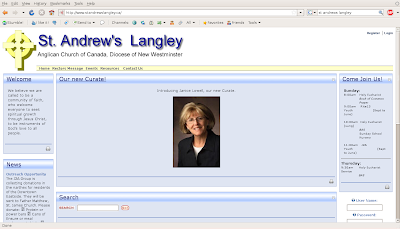
The obvious option is to post on the Church's website. Let me show you the problem with that:
Here we have a perfectly functional noticeboard. One of those ones put outside a church with the plexiglass over it and the little lock on the bottom. There is no interactivity here. Now, I'm not saying that a church website should be a social networking site. But I should have a reason to check back in on a website before I forget the url. I should want to have it as a bookmark, not have to Google it to find it.I should point out that I don't mean at all to pick on church webmasters and mistresses. Building and maintaining a website is a lot of work, and work that I certainly couldn't do. And it's not just the small churches that seem to have problematic websites. Let's take a look at the Anglican Church of Canada's website:
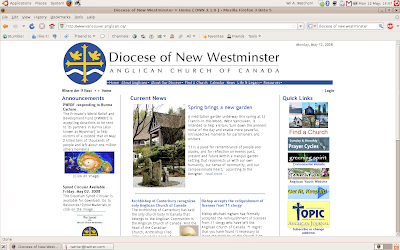
It's like an overloaded iGoogle homepage. Little boxes, little text, too many categories, poorly formatted and highly frustrating. I don't want to spend time on a website finding information, I want to spend time on a website taking information in. For a step up, I can go to my diocese's website:
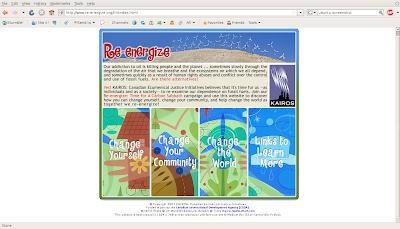
Snippets of articles with easy-to-find links if I want to read more. Broad sections with easy and consistent navigation across the top. It's solid, readable, boring and just a little bit slow. For an example of something more direct and quite a bit faster (as far as navigation goes) here is a shot from the Anglican Church of Canada's environmental initiative website:
Although the fonts, colours and graphics are clearly aimed at a "younger" audience, this is an excellent website. Simple categories with large clickable areas that lead to similiar sites further specifying information before giving you a large piece of information to read. While it may seem like more steps, this actually leads to faster navigation: the reader makes more choices to get to the information, but each choice is infinitely faster because each choice is infinitely simpler.I could go on, but I won't. The point is that church websites are ugly, boring, slow and difficult to use for the most part, but that sometimes, when the work is paid for and contracted out, we can get very usuable sites. This said, I'd love to see some advocacy (I guess I'm volunteering myself for this, aren't I?) around a Diocese-level service provision to make templates and training available for churches to use to arrange useful websites. An RFP should be developed including the building of templates and infrastructure for such a project. Now, not every individual parish will want to express themselves the same way online, which is great, so the templates need to be flexible, and there will need to be an easy way for people at the parish level to maintain these websites. This needs to be built into the RFP. Another key aspect of the RFP would be a defined, short-term training period for interested parish members. Finally, server space, bandwidth and other infrastructure considerations need to be made by the proponents responding to the RFP.
The website issue addressed, I now return to the original topic of video podcasting. Once we have a useable, enticing webspace on which to post such content, it will be a welcome addition to it. Until such a time, however, it probably makes more sense to post and host off-site with a service such as blip.tv and blogger.com or another blog website. These services focus on ease-of-use and updatability as well as a strong syndication system. My immediate recommendation would be to build a presence on one of these sevices and provide a simple-to-find link on the church's main website.
An Introduction and Some Notes
I started this project after being asked if I would juggle during Children's Time at church. I of course accepted, but the caveat was that I had to somehow relate it to the reading of the week, preferably the gospel reading. So I went away and came up with a story about learning to juggle. Now, as it turns out, Children's Time is not Sunday School as I had thought it would be. Children's Time referred to the part of the service when the kids gather at the chancel step BEFORE going off to Sunday School. Which is to say, it occurs with the entire congregation present. I was caught completely off-guard, but I don't like passing up opportunities to fail, so I went for it.
Now let me lay out this situation: all the kids gather at the front of the church and are being addressed directly, normally by the person presiding at the service. All of the older generations are present and listening as well. A message is delivered, directed at the children, then engaged in by all parties in various manners. But the discussion of the message begins with the children, at the chancel step.
Friday, May 9, 2008
Ryan Tries Anders' Stinky Soup
Anders is a new student at school. He's from Norway and doesn't speak a lot of English. He doesn't know how to play the games that all the other kids play at school. He's not very good at sports, and because he can't really talk to anyone, he doesn't invite anyone over to his house to play, and no-one invites him to play.
One day, while all the kids were eating lunch, some of the guys started making fun of Anders' lunch. His parents had packed him some cabbage stew.
"Your lunch stinks!" one of the boys yelled after the teacher left the room.
All of the others joined in shouting at Anders. Except for Ryan.
Ryan picked up his lunch, stood up and walked over to Anders, who was sitting by himself. Ryan pointed to the empty chair beside Anders. Anders didn't respond. Ryan pulled the chair out and sat beside Anders.
"Throw his stink soup at him!" another of the boys yelled.
Ryan offered Anders half of his sandwich. Anders shook his head "No." Ryan pointed to the soup and asked, "Can I try that?" Anders didn't know how to respond. Ryan held his hand out for the spoon and Anders, slowly, gave it to him. Ryan took a spoonful of the soup and smiled. He once again offered Anders the half a sandwich. Anders took it, took a bite, smiled, looked at Ryan and said "This sandwich is gross!"
Everyone in the room stopped. Ryan saw Anders' smile and started laughing at his joke.
Questions for Discussion:
1. What happens next?
2. What did the other children expect Ryan to do after Anders said his sandwich was gross?
3. Did Ryan tell the other kids to settle down?
Saturday, May 3, 2008
Kerri Gets Worried
But sometimes she still gets worried.
She always gets A's on her report cards. She has won awards at her flute recitals. She usually scores a goal or two every game and always gets trophies at the end of the season. People tell her "Good Job!" almost every day.
But sometimes she still gets worried.
Once at school, she got an answer wrong on a test. During a recital once, she missed a note in a song. One time, during a soccer game, another player checked her and then scored a goal. After each of these things, she cried after she got home. Her parents told her not to worry about it, but sometimes she still gets worried.
Questions for Discussion:
1. Why does Kerri get worried?
2. Is it Kerri's job to be the best at everything?
3. What is your job?
Monday, April 28, 2008
Emily Wants to Keep Playing
"You guys aren't allowed to play here," he said.
"We like playing!" Emily replied.
"Do you want to play too?" asked Chester.
"I don't know," Wil answered, "I don't think we're allowed."
"This is a playroom," asserted Emily, "we're allowed to play here."
"It doesn't say 'playroom' on the door or anywhere in here," whined Wil, "how can you be sure?"
"This is where the toys are!" exclaimed Victoria, who then offered Wil a ring so he could join in her game of ring-toss.
Wil accepted the ring and threw it as hard as he could across the room. Wil laughed at this because he thought it was funny, but no-one else did.
"That's not how we play," Emily patiently stated, "we need to be more careful with the toys. If we're not, we won't be allowed to play here any more."
Chester and Victoria were very cross with Wil, but they still wanted him to play with them. Victoria offered Wil another ring.
Questions for Discussion:
1. How did Emily know the rules?
2. What happened next?